
How to Reduce Conveyor Downtime by 70%: A Strategic Guide
In the industrial world, a stopped conveyor belt isn’t just a maintenance headache—it is a financial hemorrhage. For a mid-sized cement, mining, or power plant, a single hour of unplanned downtime can cost anywhere from ₹2,00,000 to ₹10,00,000 in lost throughput and idle labor.
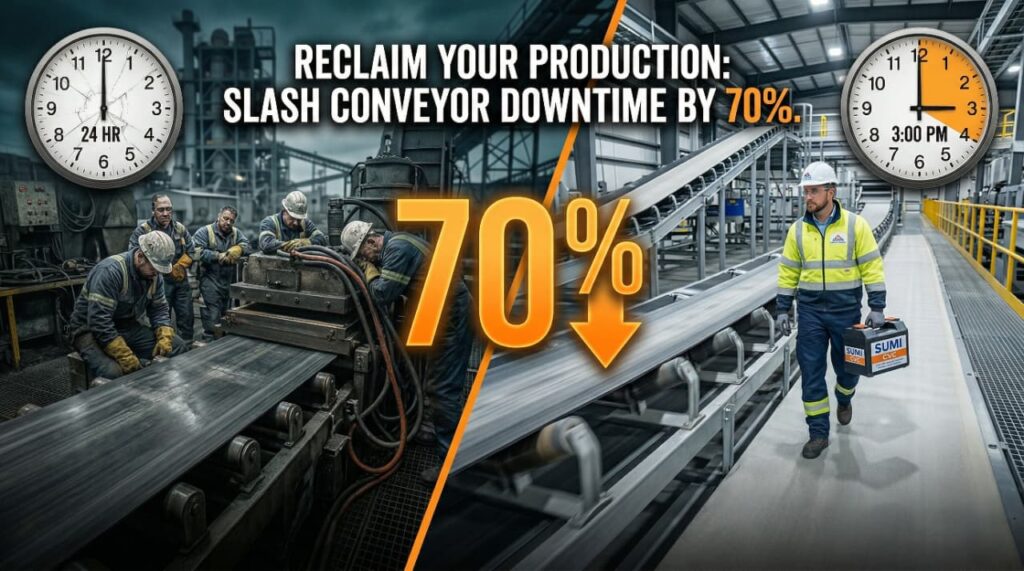
If your current maintenance cycle for a belt splice or pulley lagging takes 12 to 24 hours, you are losing millions annually in “waiting time.” The good news? Leading plants are now using advanced cold vulcanizing technology to slash that downtime by 70%. This isn’t just a repair strategy; it’s a bottom-line optimization.
1. The “Curing Gap”: Where Time is Lost
The biggest contributor to downtime isn’t usually the physical labor of the repair—it’s the curing window. Traditional industrial adhesives and hot vulcanizing methods require a “rest period” of 12–24 hours to reach full chemical cross-linking before the belt can be tensioned and run.
The Math of the 70% Reduction:
- Traditional Method: 8 Hours (Preparation/Repair) + 16 Hours (Cure) = 24 Hours Total.
- SUMI CVC Method: 4 Hours (Preparation/Repair) + 3 Hours (Cure) = 7 Hours Total.
By switching to high-performance catalysts that trigger rapid molecular bonding, you effectively reclaim 17 hours of production in a single shift.
2. Portability: Eliminating Logistics Lag
Downtime often spikes because teams are waiting for heavy equipment. Hot vulcanizing requires a 500kg+ heating press, heavy-duty power cables, and a large crew to assemble the plates. If the fault is at the top of a 30-meter high gallery or deep in an underground tunnel, the logistics alone can take 4 hours.
The Strategy: Shift your primary maintenance philosophy to Cold Vulcanizing. A high-quality cold-bonding kit is entirely portable. A single technician can carry the cement, hardener, and cleaning solvents in a shoulder bag. They can reach the fault, prep the surface, and apply the bond while the “Hot Press” team would still be loading their truck.
3. Preventing “Secondary Failures”
The most frustrating type of downtime is re-downtime—when a hasty repair fails after just 48 hours. This typically happens because the adhesive used didn’t have sufficient “Peel Strength” to handle the dynamic tension and constant flexing over the rollers.
The Technical Fix: To reduce downtime long-term, you must use an adhesive with a proven bonding strength. SUMI CVC offers a peel strength of 1.5 MPa (15 kg/cm²). This ensures that the splice doesn’t just “stick”—it becomes a permanent, integral part of the belt. High initial tack prevents edge-peeling, which is the leading cause of secondary joint failure.
4. The 80/20 Rule of Surface Preparation
80% of bond failures are caused by 20% of the process: The Cleaning Phase. Many teams waste time applying more glue to a poorly prepped surface, leading to inevitable failure.
The Professional Protocol:
- Mechanical Buffing: Use a specialized tungsten carbide disc to create a “rough” texture on the rubber without scorching it.
- Chemical Cleaning: Use a high-purity solvent to remove all oils and dust.
- The Double-Coat Method: Apply a thin primer coat of SUMI CVC, let it reach the “tack-dry” state, and then apply the second bonding coat. This creates a “mechanical lock” in the rubber pores.
5. Why SUMI CVC is the “Downtime Killer”
When every minute is measured in lakhs, you cannot afford “general purpose” hardware-store glues. SUMI CVC (Cold Vulcanizing Cement) by Sumi Industries is specifically engineered for high-speed industrial recovery.
- The 3-Hour Miracle: Specifically formulated to allow a functional restart in record time.
- Heat Resistance (80°C): Most glues soften in the summer heat or under high friction. SUMI CVC remains stable, preventing joint “creep.”
- Consistent Pot Life: It gives your technicians 30–45 minutes of working time to align the belt perfectly, but triggers a rapid, aggressive cure the moment the two surfaces are pressed together.
- 18-Month Stability: Our 18-month shelf life ensures you are always ready for emergencies.
Summary: Transforming Maintenance into Profit
Reducing your downtime from 24 hours to 7 hours isn’t just about “fixing a belt.” It is about reclaiming 17 hours of throughput. If your plant produces ₹3,00,000 worth of material per hour, that single switch to SUMI CVC has just added ₹51,00,000 back to your plant’s productivity for that day.
Ready to slash your plant’s downtime?
Explore SUMI CVC Technical Specs