
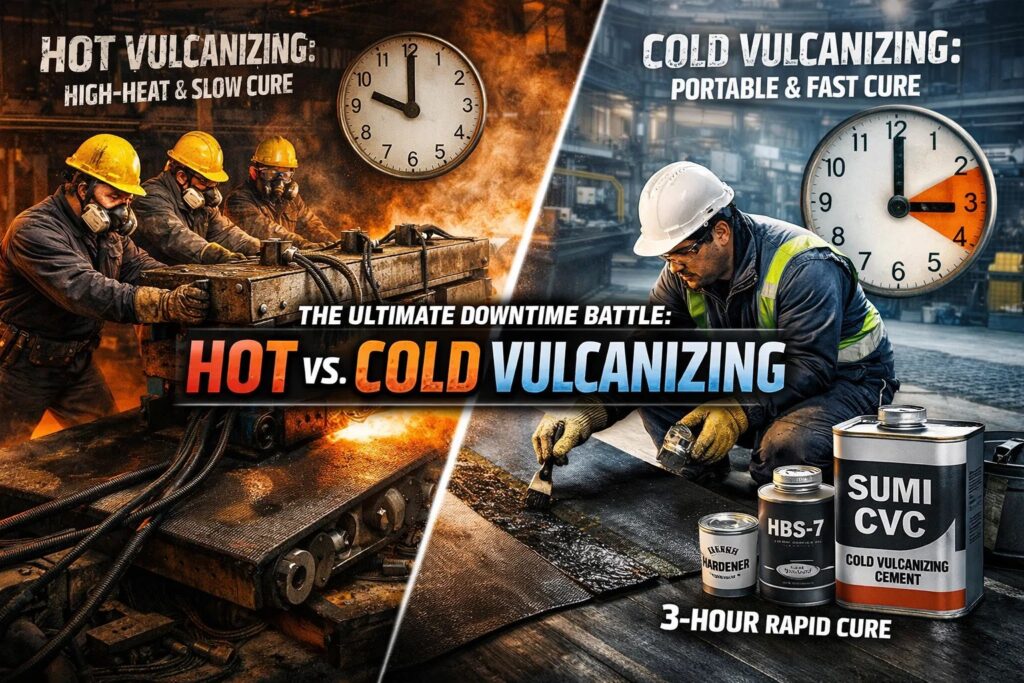
Cold vs. Hot Vulcanizing: Which is Better for Your Plant?
It’s 2:00 AM on a Tuesday. The floor of your processing plant, usually a symphony of rhythmic humming and mechanical precision, has fallen deathly silent. A primary conveyor belt—the lifeline of your entire operation—has snapped.
As the Plant Manager, you’re not just looking at a broken belt; you’re looking at a hemorrhaging balance sheet. Every minute the “out of service” sign hangs on that line, thousands of dollars in production value vanish. The pressure is on. You need a fix, and you need it now. But as you call your maintenance lead, the age-old debate resurfaces: Do we go with Hot Vulcanizing or Cold Vulcanizing?
In the high-stakes world of industrial maintenance, this choice defines your downtime, your budget, and the long-term reliability of your infrastructure. Let’s break down the battle between the “Heavy Heat” and the “Chemical Bond.”
The Traditional Giant: Hot Vulcanizing
Hot vulcanizing has long been considered the “gold standard” for heavy-duty belts. It involves a massive, heavy heating press (a vulcanizer) that applies specific pressure and temperatures—often exceeding 140°C—to physically melt and fuse the rubber ends together.
The Reality Check: While the bond is undeniably strong, the logistics are a nightmare. Bringing a 500kg heating press to a remote mining site or a cramped cement plant walkway is a Herculean task. You need a dedicated high-voltage power source, a large crew to assemble the press, and hours—sometimes days—for the heating and cooling cycles to complete. In the 2:00 AM scenario described above, Hot Vulcanizing is the slow, expensive road to recovery.
The Agile Challenger: Cold Vulcanizing
Cold vulcanizing doesn’t rely on massive machinery or external heat. Instead, it utilizes high-performance chemical bonding agents (Cold Vulcanizing Cement) to create a molecular bridge between rubber surfaces.
In the past, critics argued that cold bonds couldn’t handle the tension of hot bonds. That era is over. Modern chemical engineering has birthed solutions that rival the strength of the belt itself, all while being applied with nothing more than a brush and a roller.
The Three Pillars of Cold Vulcanizing Success:
- Unmatched Portability: You don’t need a truck to carry the solution. A technician can carry the entire repair kit in a single toolbox.
- Drastic Cost Savings: Beyond the price of the adhesive, you save on labor, equipment rental, and energy costs.
- Speed of Restart: This is the ultimate “Downtime Killer.” A cold-vulcanized joint is often already curing while a hot press is still warming up.
Technical Comparison: At a Glance
| Feature | Hot Vulcanizing | Cold Vulcanizing |
|---|---|---|
| Equipment | Heavy Heating Press & Power | Manual Tools (Brush/Roller) |
| Manpower | Large specialized crew | 1–2 skilled technicians |
| Downtime | 12–24+ Hours | 3–8 Hours |
| Initial Cost | Very High (Rental & Labor) | Low (Product & Minimal Labor) |
| On-Site Flexibility | Poor (Needs space/power) | Excellent (Can be done anywhere) |
The Hero of the Modern Plant: SUMI CVC
If you have decided that speed and efficiency are your priorities, the next question is: Which adhesive do I trust?
This is where SUMI CVC (Cold Vulcanizing Cement) by Sumi Industries changes the game. Engineered for the most grueling environments—from abrasive cement plants to high-tension mining—SUMI CVC is designed to outperform.
Why SUMI CVC is the Professional’s Choice:
- Superior Bonding Strength: Proven peel strength of over 1.5 MPa (15 kg/cm²).
- The 3-Hour Miracle: Allows for a functional restart in just 3 hours, while competitors often require 24.
- Extreme Durability: Resistant to heat up to 80°C and withstands high-speed dynamic stress.
- Ease of Use: Consistent viscosity ensures even spreading and an instant bond upon contact.
Final Verdict
Is Hot Vulcanizing dead? Not entirely. For ultra-thick steel cord belts in permanent installations, it still has its place. However, for 90% of industrial applications—including fabric ply belts, pulley lagging, and emergency splicing—Cold Vulcanizing is the smarter, faster, and more profitable choice.
Don’t let your plant stay silent longer than it has to. Equip your team with the portability of cold bonding and the unmatched strength of SUMI CVC. Because when the clock is ticking at 2:00 AM, the only thing that matters is getting that belt moving again.
Ready to upgrade your maintenance toolkit?
Explore SUMI CVC Solutions